What is Bulk Chemicals and How Are They Used in Industry?
In the world of industrial production, bulk chemicals play a vital role. These are large-volume substances used in various processes, from manufacturing plastics to pharmaceuticals. Dr. Emily Carter, a leading expert in chemical engineering, states, “Bulk chemicals are the backbone of modern industry.” Their significance cannot be overstated.
Bulk chemicals are essential for many sectors. They are the foundational materials that support large-scale manufacturing. Industries rely on these chemicals for efficiency and cost-effectiveness. However, the production and distribution of bulk chemicals come with challenges. Environmental concerns arise, as does the need for safety in handling.
The future of bulk chemicals demands innovation. Companies must balance demand with sustainability. New methods for production can reduce environmental impact. Yet, the industry must reflect on its practices. The pursuit of efficiency shouldn’t overshadow safety and sustainability. As we explore this topic, it’s crucial to question our approach to bulk chemicals and their place in industry.

Definition and Classification of Bulk Chemicals in the Chemical Industry
Bulk chemicals are essential components of the chemical industry. They are defined as large quantities of raw materials, typically produced at high volumes. These chemicals include commodities like acids, bases, and gases. Common examples are sulfuric acid, chlorine, and ammonia. According to a recent IHS Markit report, the global demand for bulk chemicals is expected to grow steadily. This growth can be attributed to various sectors such as agriculture, plastics, and pharmaceuticals.
Classification is crucial in understanding bulk chemicals. They can be categorized based on their origin: natural or synthetic. Natural chemicals come from resources like minerals or biomass. Synthetic chemicals are created through chemical processes. This differentiation helps industries optimize their production methods. The American Chemistry Council highlights that bulk chemicals represent over 70% of the total chemical production value.
Tips: Always verify sourcing. Understanding the origins of bulk chemicals helps ensure quality and safety. Additionally, keeping abreast of market trends can help industries adapt to changes. Awareness of potential pollutants is necessary. Balance production demands with environmental considerations. This is not always straightforward, as reducing waste can incur higher costs.
Key Types of Bulk Chemicals and Their Industrial Applications
Bulk chemicals play a vital role in various industries. These are produced in large quantities, serving diverse applications. Common types of bulk chemicals include acids, bases, salts, and gases. Each type has unique uses that significantly impact industrial processes.
Acids, like sulfuric acid, are crucial in manufacturing fertilizers and chemicals. They help in refining metals and in battery production. Bases, such as sodium hydroxide, find applications in soap and detergent manufacturing. These compounds contribute to many everyday products. Salts, particularly sodium chloride, serve as essential ingredients in food processing and water treatment.
Bulk gases, like ammonia and chlorine, are integral in chemical synthesis. Ammonia is important for producing fertilizers, while chlorine is used for disinfection and bleaching. It's clear that bulk chemicals facilitate numerous industrial tasks. However, ethical concerns surround their production and use. Environmental impacts linger, demanding careful management. Balancing industrial demand with sustainable practices requires ongoing reflection and improvement.
What is Bulk Chemicals and How Are They Used in Industry? - Key Types of Bulk Chemicals and Their Industrial Applications
| Chemical Type |
Description |
Industrial Applications |
Key Properties |
| Sodium Hydroxide |
A strong alkali used in various chemical processes. |
Manufacturing soap, paper production, and water treatment. |
Highly soluble in water, hygroscopic, caustic. |
| Sulfuric Acid |
A strong mineral acid with a wide range of uses. |
Fertilizer production, battery acid, and metal processing. |
Highly corrosive, dehydrating agent, dense liquid. |
| Ammonia |
A colorless gas with a distinct odor, used in fertilizers. |
Fertilizers, refrigeration, and cleaning products. |
High volatility, basicity, and excellent nitrogen source. |
| Ethylene |
A colorless gas used primarily in the production of plastics. |
Production of polyethylene, antifreeze, and solvents. |
Flammable, reactive, and used as a building block for other chemicals. |
| Propylene |
A gas used in the production of various valuable chemicals. |
Manufacturing polypropylene, antifreeze, and alcohols. |
Flammable, reactive, and undergoes polymerization. |
Market Trends and Demand for Bulk Chemicals in Various Sectors
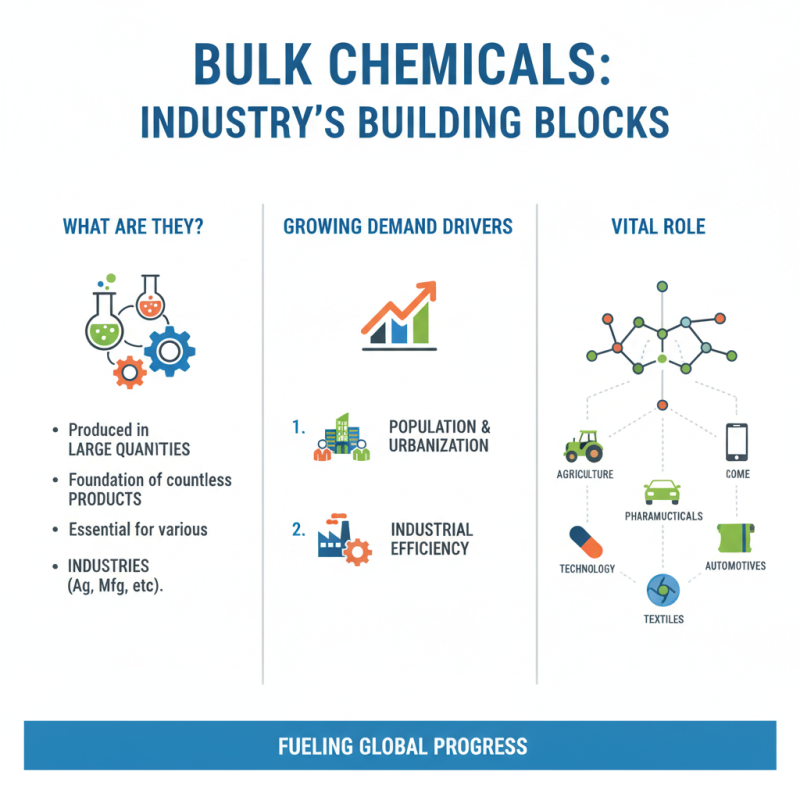
Bulk chemicals play a vital role in various industries, ranging from agriculture to manufacturing. They are produced in large quantities and are the foundation of numerous products. The demand for these chemicals is on the rise, driven by several factors. Increasing population and urbanization influence their usage. Industries need bulk chemicals to produce goods more efficiently.
In agriculture, for instance, fertilizers and herbicides are crucial for crop production. As the global population grows, the need for food supply increases. This trend leads to a higher demand for bulk chemicals like ammonium nitrate and phosphates. Meanwhile, the construction sector is consuming more chemicals like cement additives and coatings. Such trends reflect a shift towards innovation and sustainability in construction materials.
However, the growth in bulk chemical demand poses challenges. Environmental concerns arise as many production processes lead to emissions. There is pressure on the industry to adopt greener methods. As companies strive to meet these expectations, they must balance efficiency and sustainability. It’s a complex situation that requires careful consideration of future practices.
Environmental Impact and Sustainability Considerations for Bulk Chemicals
The bulk chemicals sector significantly impacts the environment. These substances are produced in large quantities. They are vital for various industries, but they come with challenges. According to a report from the American Chemistry Council, more than 80% of chemical production is for bulk chemicals. However, this can lead to pollution and resource depletion.
Environmental concerns are rising. Bulk chemicals can pollute air and waterways. For instance, a study indicated that industrial chemical discharges contribute to 25% of global water contamination. The production of these chemicals often results in greenhouse gas emissions. A shift toward sustainable practices is necessary. Companies are exploring greener alternatives and technologies.
Reducing waste is another crucial factor. Data shows that the chemical industry generates millions of tons of waste annually. Many practices remain outdated. The need for innovation in waste management and recycling is evident. Industry stakeholders must prioritize sustainability to minimize their ecological footprint. Solutions are available, but action is slow. The challenge lies in balancing production demands with environmental responsibility.
Usage of Bulk Chemicals in Various Industries
Future Innovations and Technological Advancements in Bulk Chemical Production
The future of bulk chemical production is filled with potential. Innovations are emerging, driven by the need for sustainability. Companies are developing methods to reduce waste and energy usage. For instance, bioprocessing techniques are gaining traction. They utilize biological materials for chemical production. This could lead to cleaner processes.
Advancements in technology are also transforming bulk chemical production. Automation and data analytics improve efficiency. Smart sensors monitor production in real-time. This helps identify issues before they escalate. However, challenges remain. Not all facilities can afford these technologies. Small companies may struggle to keep up.
Research into alternative feedstocks is another area of interest. Utilizing renewable resources can lessen reliance on fossil fuels. Innovations in catalyst design could enhance reaction rates. Yet, these advancements must be thoroughly tested. It’s crucial to ensure they are both effective and environmentally friendly. The path to advancement is not without obstacles.