How to Choose the Best Gas Atomized Metal Powder for Your Needs?
Choosing the right Gas Atomized Metal Powder is essential for various applications. The correct selection can significantly impact performance and outcomes. Gas atomized metal powder is widely used in additive manufacturing, aerospace, and automotive industries. This material offers exceptional quality and consistency, making it a preferred choice among many professionals.
Understanding your specific needs is crucial in this selection process. Factors such as particle size, flowability, and chemical composition play a vital role. Each application may require different properties. For instance, finer powders might be needed for detailed prints, while coarser powders may work for bulk manufacturing.
Exploring different suppliers can be overwhelming. Not all manufacturers provide the same quality of gas atomized metal powder. It’s important to evaluate their reliability and expertise. Reviewing industry standards and certifications can help ensure the powder meets necessary specifications. Additionally, seeking recommendations from experienced professionals can provide valuable insights. Selecting the right material might require effort and reflection, but it ultimately pays off in the final product’s quality.
Understanding Gas Atomization Process for Metal Powder Production
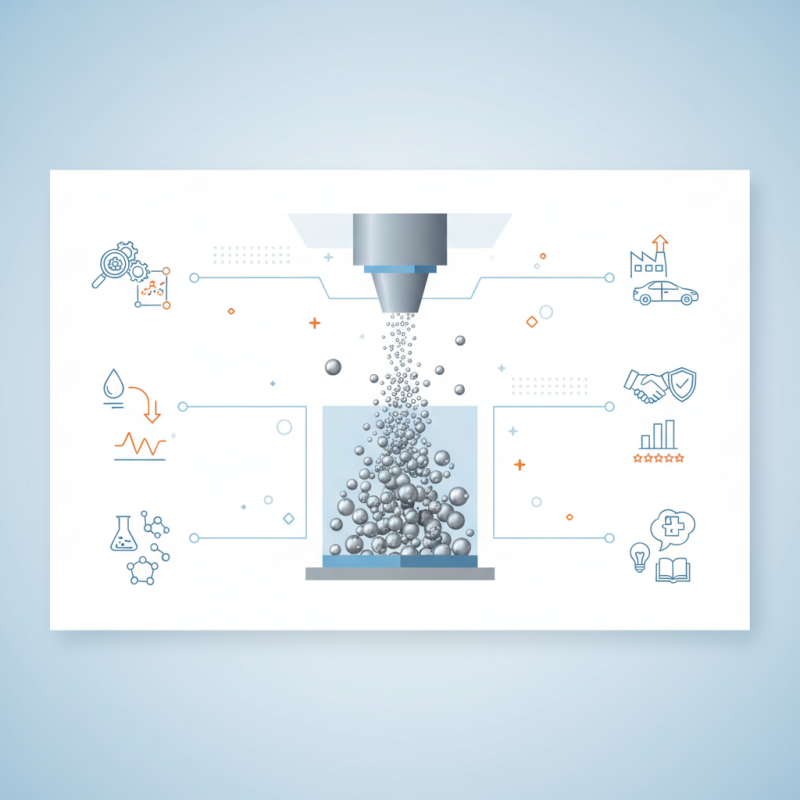
Gas atomization is a critical process in producing high-quality metal powders. It involves melting metal and dispersing it into fine droplets using high-pressure gas. This technique results in uniform particle size and shape, which are essential for various applications. The effectiveness of gas atomization lies in its ability to quickly cool and solidify the metal, preventing oxidation and contamination.
Understanding the factors that influence gas atomization can lead to better material choices. Droplet size, flow rate, and gas composition are vital. Specific needs may require different gas types, such as nitrogen or argon, as they affect the properties of the final powder. Conducting experiments to find optimal settings can offer significant advantages.
Tips: Always consult with experts when selecting gas atomization parameters. Perform small-scale tests before large batch production. Monitor the cooling rates during atomization for consistency. Emphasizing precision in these steps can lead to improvements in quality and performance. Remember, sometimes the best results come from trial and error.
Identifying Material Properties Relevant to Your Application
When selecting metal powders, understanding material properties is crucial. Different applications require unique characteristics. For example, strength, ductility, and thermal conductivity play significant roles in performance. Knowing the intended application helps narrow down choices.
Consider the particle size and shape of the powder. Fine powders can improve sintering, while larger particles may be ideal for certain applications. However, using inappropriate sizes might lead to inconsistencies. Always evaluate how these factors impact the final product quality.
Moreover, consider the flowability of the powders. Good flow improves the efficiency of the manufacturing process. Poor flow can create defects. It's essential to experiment and refine choices based on project needs. Learning from past experiences can improve these selections over time. Aim for a balance of properties that align closely with your application's demands.
How to Choose the Best Gas Atomized Metal Powder for Your Needs?
| Property | Description | Importance | Applications |
| Particle Size | Refers to the diameter of the powder particles, typically measured in microns. | Critical for determining flowability and packing density. | 3D printing, coating, and additive manufacturing. |
| Chemical Composition | The elemental makeup of the metal powder, including additives. | Influences physical properties and corrosion resistance. | Aerospace, automotive, and medical applications. |
| Morphology | The shape and structure of the particles, which can impact flow and packing. | Affects processing efficiency and product quality. | Metal injection molding and powder metallurgy. |
| Tap Density | The density of the powder when subjected to tapping or compaction. | Determines storage and handling considerations. | Storage and quality control in manufacturing processes. |
| Flowability | The ability of the powder to flow freely under gravity. | Essential for uniform and consistent filling in processes. | 3D printing and powder feeding systems. |
Comparing Different Types of Gas Atomized Metal Powders
When selecting gas atomized metal powders, it’s essential to understand the different types available. Each category has unique properties that can influence your project greatly. Common options include stainless steel, aluminum, and nickel-based powders. These materials vary in flowability, particle size, and thermal conductivity, impacting end-use performance.
Stainless steel powders offer excellent corrosion resistance. They are often chosen for applications requiring durability and strength. Aluminum powders, on the other hand, are lighter and have excellent thermal properties. These are favored in aerospace applications where weight is a critical factor. Nickel-based powders exhibit high-temperature resistance, making them suitable for advanced engineering tasks.
Choosing the right powder means considering not just the material properties but also application context. There is no one-size-fits-all solution. Sometimes, compromises are necessary. Perhaps you need a blend for specific mechanical properties. You may also find that availability limits your options. Each decision should weigh the unique needs of your project and the characteristics of the metals.
Evaluating Quality Metrics for Gas Atomized Metal Powders
When selecting gas atomized metal powders, evaluating quality metrics is crucial. The first consideration is particle size distribution. This affects flowability and packing density. A narrow size range is often preferred for uniformity. Analyzing this can require specialized equipment.
Another important metric is morphology. Irregular morphologies may enhance inter-part bonding during sintering. However, they can also influence flow characteristics negatively. Understanding the balance is essential.
Tips: Always request sample powders. This allows for testing in your specific application before full-scale purchasing. Don't overlook powder purity. Contaminants can lead to defects in the final product. Regular quality checks can ensure consistent performance.
A clear understanding of these metrics will guide you toward making informed choices. Yet, the variability in raw materials means that no single metric can guarantee success. Different applications may necessitate different properties. Don't shy away from reevaluating your criteria as your needs evolve.
Assessing Cost Factors in the Selection of Metal Powder for Use
When assessing metal powders for your projects, cost factors play a crucial role. The price is not just a number; it reflects quality and performance. Higher-quality gas atomized metal powders often come at a premium. This can be justified by finer particle sizes and better flow characteristics. However, cheaper options might compromise these attributes, affecting your final product's integrity.
Consider the application of the metal powder. If you are producing critical components, investing in higher-quality materials is advisable. But not every project demands the best. Sometimes, a mid-range powder might suffice for less demanding applications. Understanding your specific needs helps prevent overspending. A detailed cost-benefit analysis can reveal areas to save without sacrificing quality.
Don’t overlook additional expenses beyond the purchase price. Transportation, storage, and handling can impact your total investment. It’s essential to factor in these elements when selecting your metal powder. Even small savings in purchasing might be lost in logistics. Reflect on the entire process to ensure you make a well-informed decision. Balancing cost and performance can be challenging, but necessary for the project's success.
Cost Comparison of Different Types of Gas Atomized Metal Powders
This chart displays the average cost per kilogram of various gas atomized metal powders. Understanding the cost can significantly impact your choice of metal powder based on your specific application needs.

