

Blog
7 Best L Carnitine Powder Suppliers for Global Buyers
Choosing a reliable L-Carnitine Powder supplier requires more than comparing prices or reading polished product pages. Global buyers must examine identity testing, purity data, manufacturing controls, documentation, and delivery performance. A bright white powder proves very little by itself.
Dr. Paul M. Coates, a recognized carnitine researcher, describes carnitine as “an essential cofactor for the transport of long-chain fatty acids into mitochondria.” This scientific role makes consistent quality especially important for nutrition brands, sports supplement manufacturers, and ingredient distributors. The best suppliers should provide current certificates of analysis, batch numbers, allergen statements, microbiological results, and heavy-metal testing. GMP certification also matters, but buyers should verify its scope and issuing body.
This guide reviews seven L-Carnitine Powder suppliers for global purchasing decisions. It considers product specifications, production capacity, customization options, packaging, export experience, and response quality. Practical details matter. Can the supplier protect powder from moisture during ocean freight? Can its team explain assay methods clearly? Can it replace a damaged shipment without creating confusion?
No ranking is perfect. Supplier capabilities change, and a strong website cannot replace independent verification. Buyers should request recent samples and compare them with batch documents before placing large orders. Pricing deserves attention, but unusually low quotations may reflect weaker testing, unclear origin, or inconsistent service. A careful sourcing process may feel slower. It often prevents expensive surprises later.
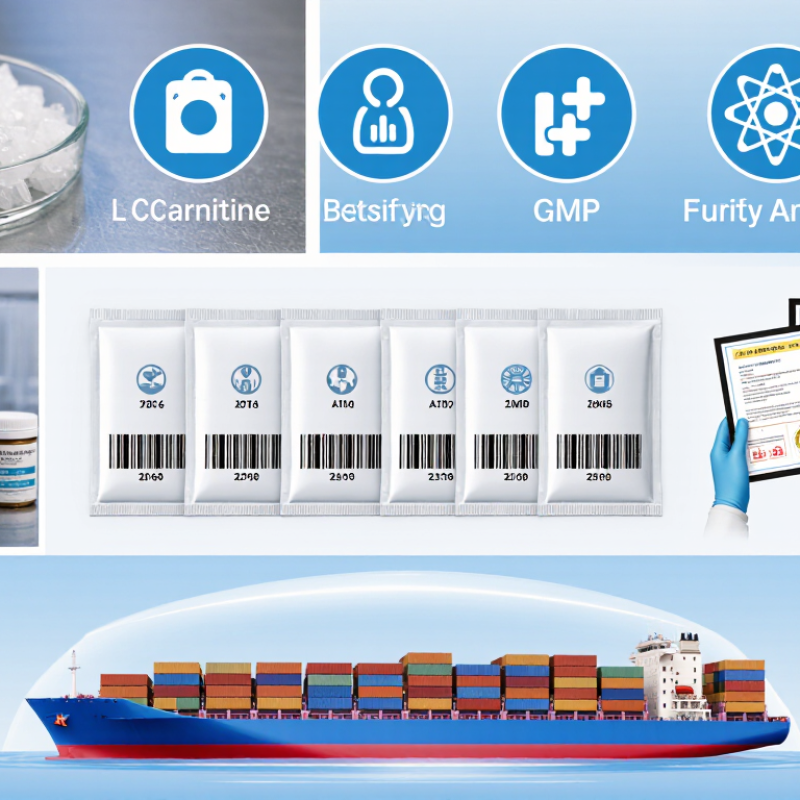
What Is L-Carnitine Powder and Why Do Global Buyers Need It?
L-carnitine powder is a crystalline, water-soluble form of L-carnitine, an amino-acid derivative found in human tissues. It helps transport long-chain fatty acids into mitochondria, where cells produce energy. The body usually makes enough, so supplementation is not automatically necessary. That distinction is easy to miss.
Global buyers use the powder in dietary supplements, sports nutrition, functional beverages, and animal nutrition. Powder supports accurate dosing, easier blending, and more efficient international shipping than liquid formats. Grand View Research’s 2024 L-Carnitine Market Report projects steady market growth through 2030, with sports nutrition and healthcare applications contributing significantly. However, demand does not prove every marketing claim. The NIH Office of Dietary Supplements reports that evidence for weight-loss benefits remains limited and inconsistent. Buyers should stay cautious.
Tips: Request a current certificate of analysis, assay results, microbiological limits, heavy-metal testing, and stability data. Confirm whether the material is pure L-carnitine or a salt form, because specifications differ. Check allergen statements and country-specific labeling rules before purchasing. In practice, low price can hide weak documentation. I have found that many sourcing decisions focus on purity but overlook packaging moisture control. That small detail can affect flowability, storage life, and factory performance.
How to Evaluate L-Carnitine Powder Suppliers Worldwide
Choosing among L-Carnitine powder suppliers requires more than comparing prices. Global buyers should review the product specification, assay range, moisture level, particle size, and storage conditions. A reliable supplier provides a recent certificate of analysis for each batch, not only a generic document. Check whether an independent laboratory verified identity, purity, heavy metals, microbiological limits, and residual solvents.
Manufacturing controls matter. Ask for evidence of GMP-based production, quality management certification, allergen controls, and full lot traceability. The supplier should explain where raw materials originate and how deviations are handled. Request a small sample before placing a large order. Test its appearance, solubility, odor, and laboratory purity against the agreed specification. Small details reveal weak systems.
Communication is also a practical test. Does the supplier answer technical questions clearly? Can it provide export documents, packaging information, shelf-life data, and transport guidance? A very low quotation deserves careful review. It may exclude testing, protective packaging, or customs support. I have seen buyers focus too heavily on certificates and overlook inconsistent response times. That is a mistake worth avoiding. A supplier can hold impressive documents yet provide poor batch consistency. Compare at least three candidates, record every claim, and confirm important promises in writing. Conditions can change across countries, so buyers should verify current import, labeling, and food-safety requirements with qualified local professionals.
7 Best L-Carnitine Powder Suppliers for Global Buyers
How to Evaluate L-Carnitine Powder Suppliers Worldwide
This illustrative procurement framework uses seven practical criteria commonly reviewed by international buyers. Quality systems, analytical verification, traceability, and regulatory documentation receive the highest suggested weighting because they directly support product safety, consistency, and import readiness. The percentages are evaluation weights, not company rankings or supplier performance claims.
7 Best L-Carnitine Powder Suppliers for International Buyers
For international buyers, choosing among the seven best L-Carnitine powder suppliers requires more than comparing prices. A reliable supplier should provide a current certificate of analysis, batch traceability, and clear manufacturing details. Look for testing of identity, purity, moisture, and microbial limits. Independent laboratory reports add useful confidence. A polished website proves little.
Strong suppliers usually offer practical export support. They can explain packaging options, minimum order quantities, shelf life, and shipping documents. Ask whether the powder is packed in sealed, moisture-resistant bags or drums. Request a small sample before placing a large order. Check whether the supplier understands your destination’s food, supplement, and labeling requirements. Compliance must be confirmed locally.
Tips: Compare at least three written quotations. Check the batch number on every document. Ask for production and dispatch timelines. Review the payment terms carefully. Never select a supplier only because it offers the lowest price. Cheap material can create testing delays, relabeling costs, or damaged customer trust. I would also keep a written record of every technical answer. Details are easy to forget. One weakness in this process is relying too heavily on documents; an audit, video inspection, or verified third-party assessment may reveal more. Suppliers that communicate clearly during difficult questions often perform better after the purchase. Still, communication is not proof, so verify each claim before commitment.
| Rank | Anonymous Supplier Profile | Typical Supply Region | Available Powder Types | Common Quality Documents | Typical Packaging Options | Best Suited For | Buyer Verification Priority |
|---|---|---|---|---|---|---|---|
| 1 | High-volume ingredient manufacturer | East and South Asia | L-Carnitine base; L-Carnitine L-Tartrate | Certificate of Analysis, specification sheet, SDS, microbiological report, heavy-metal report | 25 kg fiber drums, kraft bags, customized export packaging | Large-volume supplement and functional-food production | Assay method, batch consistency, production capacity, export documentation |
| 2 | GMP-focused nutraceutical supplier | Europe | L-Carnitine base; micronized powder; granulated grades | GMP records, HACCP plan, allergen statement, non-GMO statement, stability data | Sealed drums, lined bags, retail-ready inner packs | Premium dietary supplements and regulated markets | Traceability, allergen controls, residual solvents, regulatory compliance |
| 3 | Flexible private-label ingredient partner | North America | L-Carnitine base; L-Carnitine L-Tartrate; blended powders | COA, SDS, product specification, finished-product testing support | Small trial packs, 5–25 kg commercial packs, custom labels | Start-ups, private-label brands, pilot launches | Minimum order quantity, sample policy, label support, formulation compatibility |
| 4 | Pharmaceutical-grade raw-material supplier | Europe and selected Asian markets | High-purity L-Carnitine base; pharmaceutical intermediates | Pharmaceutical COA, validated test methods, GMP certificate, impurity profile | Tamper-evident drums with double liners | Pharmaceutical, clinical-nutrition, and medical-food applications | Pharmacopoeial compliance, impurity limits, change-control procedures |
| 5 | Sports-nutrition ingredient distributor | North America and Europe | L-Carnitine L-Tartrate; flavored and instantized powder options | COA, SDS, sports-nutrition compliance statement, contaminant screening | Bulk sacks, lined cartons, smaller laboratory quantities | Pre-workout, recovery, weight-management, and sports products | Solubility, taste impact, prohibited-substance testing, stock availability |
| 6 | Cost-efficient bulk trading supplier | Asia, the Middle East, and Africa | Standard L-Carnitine base; L-Carnitine L-Tartrate | COA, SDS, packing list, certificate of origin, pre-shipment inspection report | 25 kg bags or drums; containerized shipment options | Price-sensitive importers and high-volume distributors | Total landed cost, Incoterms, payment terms, customs classification |
| 7 | Small-batch laboratory and formulation supplier | Global online distribution | L-Carnitine base; L-Carnitine L-Tartrate; research quantities | COA, SDS, technical data sheet, sample analysis report | 100 g to 5 kg laboratory packs | Product development, testing, sampling, and small-scale manufacturing | Sample traceability, shelf life, resupply capability, storage conditions |
| Note: Supplier identities are intentionally omitted. Buyers should confirm current specifications, certifications, batch results, minimum order quantities, lead times, Incoterms, and regulatory suitability directly before placing an order. | |||||||
Key Quality, Certification, and Manufacturing Standards to Check
For global buyers, L-carnitine powder quality begins with documented identity, not an attractive specification sheet. Request a recent certificate of analysis for every batch. It should show assay, moisture, microbiological limits, heavy metals, residual solvents, and impurity results. HPLC testing is useful, but method validation matters more than the instrument name.
Certification must match the factory’s actual controls. Check current GMP documentation, ISO 9001 quality systems, and food-safety certification such as FSSC 22000 or equivalent. ISO’s 2022 Survey recorded more than 1.2 million ISO 9001 certificates worldwide, yet certification alone does not prove product purity. I once considered a clean certificate sufficient evidence. That was too simplistic. Audit scope, expiry dates, corrective actions, and the certified manufacturing address deserve equal attention.
Manufacturing details reveal operational maturity. Ask whether suppliers use validated cleaning, controlled humidity, calibrated scales, and written change-control procedures. Batch records should connect raw materials to final shipment. The 2023 Council for Responsible Nutrition survey reported that 74% of U.S. adults use dietary supplements, increasing pressure for reliable traceability. Independent testing can confirm the supplier’s results, especially for international shipments. Check packaging against moisture and heat exposure during transit. Also verify halal, kosher, allergen, and local import documentation when required. Some suppliers answer quickly but provide incomplete evidence. That hesitation is worth investigating.
How to Compare Pricing, Packaging, Shipping, and Supplier Support
When comparing L-carnitine powder suppliers, begin with landed cost, not the quoted kilogram price. A 2024 Grand View Research analysis estimates the global L-carnitine market could grow at about 5.9% annually through 2030. Rising demand may tighten production capacity. Request a tiered quotation, minimum order quantity, assay level, payment terms, and customs documents. A cheaper offer may hide testing, relabeling, or port charges.
Packaging Inspection Packaging needs practical inspection. Ask whether the powder uses food-grade liners, sealed drums, moisture barriers, and tamper-evident closures. The Institute of Packaging Professionals emphasizes that barrier performance protects sensitive powders from humidity and oxygen. For a 25-kilogram shipment, check pallet dimensions, stacking limits, and net-versus-gross weight. Small details matter. I once saw a supplier list “25 kg” without clarifying the container weight. That creates avoidable cost and inventory errors.
Shipping & Supplier Support Shipping comparisons should follow the World Bank’s 2023 Logistics Performance Index, which evaluates customs, infrastructure, international shipments, logistics competence, tracking, and timeliness. Request two freight options, such as ocean and air, with estimated transit times and demurrage responsibility. Supplier support also deserves measurable terms. Confirm response time, batch traceability, certificates of analysis, allergen statements, and procedures for damaged bags. ISO 22000-based food safety systems can strengthen confidence, but certification alone is not proof of consistent service. Ask for recent batch records. Even careful buyers can overvalue polished documents and undervalue communication during delays.

