Top 10 Types of Polyamide Material for Global Buyers

Choosing the right Polyamide Material is rarely a simple matter of comparing prices. Global buyers must examine strength, moisture absorption, heat resistance, processing behavior, and supply stability. A material that performs well in a dry laboratory may behave differently inside a hot engine compartment or humid coastal warehouse.

This guide reviews ten widely used polyamide types, including PA6, PA66, PA11, PA12, PA610, PA612, PA46, and high-temperature grades such as PPA. Each type has a distinct balance of stiffness, impact resistance, chemical tolerance, weight, and cost. For example, PA66 often suits demanding mechanical parts, while PA12 may support flexible tubing and fuel-related applications. Bio-based options can also reduce fossil dependence, but their environmental claims require careful verification.

Details matter.

Our recommendations reflect common engineering practice, supplier documentation, and buyer-side evaluation needs. We consider resin data sheets, test certificates, molding conditions, batch consistency, and application history. However, no universal ranking can replace application testing. This is where many purchasing decisions become weak. A supplier may quote excellent tensile strength, yet overlook moisture conditioning or weld-line performance. Buyers should request samples, confirm applicable standards, and compare total cost rather than unit price alone. This article offers a practical starting point, while leaving room for technical review, regional availability, and informed reconsideration.

Top 10 Types of Polyamide Material for Global Buyers

Polyamide Materials: Definition, Structure, and Key Performance Traits

Polyamide is an engineering polymer built from repeating amide groups, written as –CO–NH–. These groups form hydrogen bonds between molecular chains. That structure gives polyamide strong tensile performance, abrasion resistance, and useful thermal stability. The top ten types include PA6, PA66, PA11, PA12, PA46, PA610, PA612, PA1010, PA6T, and PA9T. Their chain length, crystallinity, and aromatic content create different performance profiles.

PA6 and PA66 offer dependable strength for gears, cable ties, and machine housings. PA11 and PA12 absorb less moisture, so they suit flexible tubing and outdoor components. PA46, PA6T, and PA9T tolerate higher continuous temperatures. PA610, PA612, and PA1010 provide lower moisture uptake with partly bio-based options.

Still, “high performance” is not absolute. Moisture can soften some grades and change dimensions. I have seen designs fail when dry laboratory data replaced real humidity testing.

Tips: Check moisture absorption, not only tensile strength. Test parts after conditioning at expected humidity. For high heat, compare long-term temperature data, not short thermal peaks. Reinforcing fibers can improve stiffness, but they may increase warpage and reduce impact resistance. Processing matters, too. Dry resin carefully, control mold temperature, and verify shrinkage before approving mass production.

The Ten Main Polyamide Types Used in Global Manufacturing

The Ten Main Polyamide Types Used in Global Manufacturing

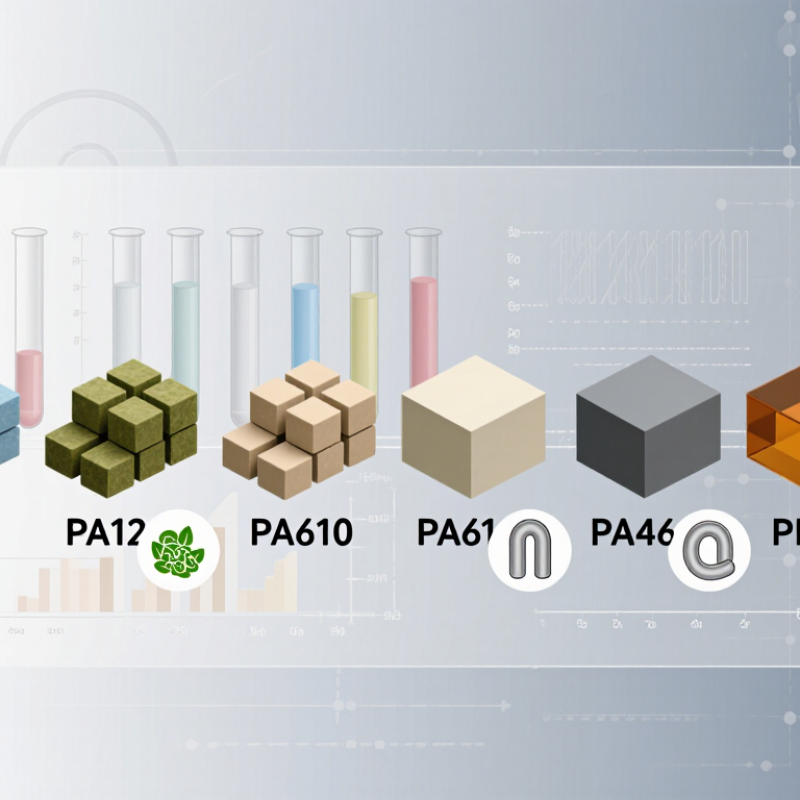
Global manufacturing relies on ten major polyamide types, each serving a different performance need. PA6 offers balanced strength, toughness, and easy processing. PA66 provides higher heat resistance and stiffness. PA11 and PA12 absorb less moisture, making them useful for tubing, seals, and flexible components. PA46 withstands elevated temperatures but often requires careful molding control. PA610 and PA612 provide lower moisture uptake than standard nylon grades. PA1010 uses a partially bio-based raw material and supports lightweight engineering designs. Aramid polyamides deliver exceptional strength and heat resistance in fiber applications. Semi-aromatic PPA performs well around heat, chemicals, and demanding mechanical loads.

Material selection should begin with the working environment, not a familiar resin name. A buyer should check temperature cycles, humidity, impact requirements, chemical exposure, and wall thickness. Moisture can change dimensions and reduce stiffness, especially in PA6 and PA66 parts. Drying conditions matter too. Poor storage can create misleading test results.

Suppliers should provide technical data, processing guidance, and batch traceability. Independent testing remains valuable for safety-critical components. A laboratory number does not always predict factory performance. That is easy to forget. Cost comparisons should include drying equipment, tooling wear, cycle time, and rejected parts. The “best” polyamide may still fail when the design ignores weld lines, shrinkage, or long-term aging. Polyamide selection is practical engineering, but it is never perfectly universal.

Top 10 Types of Polyamide Material for Global Buyers

The chart compares representative nominal melting points of ten polyamide families commonly used in global manufacturing. Actual values vary by formulation, copolymer content, reinforcement, and processing grade.

Higher-melting polyamides are generally selected for elevated-temperature applications, while lower-melting grades are often preferred for flexibility, chemical resistance, and easier processing.

Properties, Applications, and Limitations of Each Polyamide Type

Top 10 Types of Polyamide Material for Global Buyers

Polyamide 6 offers strong impact resistance and easy processing. It suits gears, cable ties, and injection-molded housings. However, it absorbs moisture, causing dimensional changes in humid warehouses. Polyamide 66 handles higher heat and stiffness. Automotive brackets and electrical connectors often use it. Its processing window is narrower, and it can become brittle after prolonged heat exposure. Polyamide 11 provides flexibility, chemical resistance, and low-temperature toughness. Tubing and fuel-system parts benefit from these properties. Its cost is usually higher. Polyamide 12 absorbs less moisture and maintains stable dimensions. It fits pneumatic lines and precision components. Yet, its lower stiffness limits heavily loaded structures.

Polyamide 46 performs well in continuous high-temperature environments. It is useful for engine-adjacent parts and compact electrical components. Difficult molding conditions can increase manufacturing waste. Polyamide 610 and polyamide 612 offer lower moisture uptake than PA6. They suit brushes, films, and dimension-sensitive parts. Their strength is generally lower than PA66. Glass-filled grades improve stiffness, but they may wear mating surfaces. Semi-aromatic PA6T provides strong heat resistance and electrical stability. It supports connectors exposed to soldering temperatures. Processing equipment must control heat carefully.

Semi-aromatic PA9T combines low moisture absorption with durable mechanical performance. It serves high-frequency connectors and precision housings. Material availability can vary between regions. Aramid polyamide delivers exceptional strength and thermal resistance. Protective fabrics and reinforcement layers use it. It is expensive and difficult to recycle through ordinary methods. In buyer trials, a dry-condition test often looks impressive. Humidity testing may tell a different story. Selection should include temperature, moisture, chemical contact, processing limits, and actual load cycles.

Top 10 Types of Polyamide Material for Global Buyers - Properties, Applications, and Limitations of Each Polyamide Type
Rank Polyamide Type Typical Density
(g/cm³)
Typical Melting Point
(°C)
Moisture Absorption Key Properties Common Applications Main Limitations Buyer Considerations
1 PA 6 (Nylon 6) Approximately 1.13–1.15 Approximately 215–225 Moderate to high; commonly about 2–3% at standard conditioning, with higher values possible at high humidity Good strength, toughness, abrasion resistance, fatigue resistance, and processing versatility. Easy to reinforce with glass fiber or mineral fillers. Automotive components, electrical housings, cable ties, gears, consumer goods, films, fibers, and industrial parts. Moisture significantly affects dimensions, stiffness, and electrical insulation. Not the best choice for prolonged high-temperature service without stabilization. Specify moisture-conditioned mechanical data, glass-fiber content, heat stabilization, flame-retardant grade, and molding shrinkage.
2 PA 66 (Nylon 6,6) Approximately 1.13–1.15 Approximately 255–265 Moderate to high; commonly about 2–3% at standard conditioning Higher heat resistance, stiffness, strength, and wear performance than many standard PA 6 grades. Strong performance in structural applications. Automotive under-hood parts, bearings, gears, connectors, electrical components, industrial fasteners, and high-strength fibers. Moisture uptake can alter dimensions and properties. Higher processing temperature and relatively narrow processing window can increase molding demands. Check long-term heat-aging data, residence-time limits, mold-temperature requirements, and availability of reinforced grades.
3 PA 11 (Nylon 11) Approximately 1.03–1.05 Approximately 185–190 Low to moderate; generally lower than PA 6 and PA 66 Low moisture sensitivity, excellent flexibility, good impact resistance, strong chemical resistance, and good resistance to hydrocarbons and salts. Fuel lines, pneumatic tubing, hydraulic hoses, oil and gas components, medical tubing, flexible coatings, and powder coatings. Lower stiffness and heat resistance than PA 66. Usually higher material cost and less suitable for highly rigid structural parts. Evaluate flexibility at low temperature, chemical exposure, pressure cycling, regulatory requirements, and total lifecycle cost.
4 PA 12 (Nylon 12) Approximately 1.01–1.03 Approximately 175–180 Low; typically around 0.7–1.0% at standard conditioning Low water absorption, excellent dimensional stability, good impact strength, flexibility, chemical resistance, and surface quality. Fluid lines, pneumatic systems, automotive tubing, cable sheathing, powder-bed additive manufacturing, connectors, and consumer components. Lower modulus and heat resistance than PA 6 and PA 66. Long-term exposure to some fuels, solvents, or high temperatures requires validation. Confirm pressure rating, permeation performance, UV stabilization, additive-manufacturing powder specifications, and wall-thickness tolerances.
5 PA 46 Approximately 1.18–1.20 Approximately 285–295 Moderate to high; similar moisture-related conditioning effects to other aliphatic polyamides Very high crystallinity, strong retention of stiffness at elevated temperatures, good wear resistance, and strong resistance to repeated mechanical loading. Engine-bay parts, gears, bearings, clips, electrical connectors, and components exposed to high cyclic temperatures. Requires high processing temperatures and careful mold-temperature control. Moisture sensitivity and material cost can be significant. Review tool-steel requirements, drying procedures, weld-line strength, heat-aging curves, and production-cycle capability.
6 PA 6T (Semi-aromatic Polyamide) Approximately 1.30–1.45, depending on formulation and reinforcement Approximately 300–325 Moderate; lower dimensional response than many standard aliphatic nylons, but still affected by humidity High heat resistance, high stiffness, strong dimensional stability, good solder-reflow performance, and useful electrical properties. Automotive connectors, high-temperature electrical components, sensors, coil forms, and precision engineering parts. High processing temperature, higher tooling and equipment requirements, possible brittleness in some formulations, and increased cost. Confirm whether the grade is fully or partially aromatic, reflow profile compatibility, flame rating, CTI, and moisture-conditioning requirements.
7 PA 9T (Semi-aromatic Polyamide) Approximately 1.15–1.25 Approximately 300–310 Low to moderate; generally lower than PA 6 and PA 66 High heat resistance, low moisture uptake, good dimensional stability, strong electrical insulation, and good resistance to soldering temperatures. Fine-pitch connectors, LED components, camera modules, automotive electronics, and compact electrical housings. Higher cost, specialized processing conditions, limited availability in some regions, and potential brittleness in thin sections. Check connector warpage, laser-marking performance, color stability, reflow resistance, and regional supply continuity.
8 PA MXD6 (Semi-aromatic Polyamide) Approximately 1.20–1.25 Approximately 235–245 Moderate; moisture can influence mechanical and barrier performance High strength and modulus, good gas and carbon-dioxide barrier properties, strong dimensional stability, and useful transparency in selected structures. Multilayer food and beverage packaging, barrier films, bottles, containers, and selected engineering applications. Lower impact toughness than some aliphatic nylons, processing sensitivity, and possible loss of barrier performance after prolonged moisture exposure. Verify food-contact compliance, barrier testing method, humidity conditioning, layer adhesion, and recycling compatibility.
9 PA 610 Approximately 1.07–1.09 Approximately 215–225 Lower than PA 6 and PA 66; typically moderate Balanced strength, lower moisture absorption, good dimensional stability, good abrasion resistance, and a useful combination of toughness and chemical resistance. Industrial bristles, tubing, cable components, gears, precision parts, monofilaments, and molded engineering components. Lower stiffness and heat resistance than PA 66. May have a higher price and narrower supply base than mainstream nylon grades. Compare conditioned and dry-as-molded properties, confirm bio-based content if relevant, and evaluate supply by region.
10 Aramid Polyamide Approximately 1.38–1.45 for para-aramid fibers; varies by grade Does not exhibit a conventional melt-processing point; decomposes at very high temperature Low to moderate, depending on fiber type, finish, and construction Exceptional tensile strength or heat resistance, low creep, high modulus, strong cut resistance, and excellent performance in demanding fiber applications. Protective clothing, ropes, tire reinforcement, ballistic protection, friction materials, composite reinforcement, and heat-resistant textiles. High cost, limited melt processability, sensitivity to ultraviolet exposure in some constructions, and reduced performance in certain chemical or moisture environments. Specify para-aramid or meta-aramid, fiber form, denier, tensile properties, coating or finish, UV protection, and applicable safety standards.
Note: Values are typical reference ranges for unfilled or commonly supplied material forms. Actual performance depends on polymer formulation, additives, reinforcement, processing conditions, conditioning, test method, and product design.

How Global Buyers Compare Polyamide Grades and Specifications

Global buyers comparing polyamide grades should begin with service conditions, not price. Polyamide 6 offers balanced strength and processability for molded components. Polyamide 66 generally provides higher heat resistance and stiffness. Polyamide 12 absorbs less moisture, making it useful for fluid lines and precision parts. Long-chain grades can cost more.

Reinforcement changes the decision. Glass-fiber-filled grades improve stiffness, but they may increase warpage and reduce impact performance. Flame-retardant grades support electrical applications, yet additives can affect color, flow, and recyclability. Polyphthalamide and other high-temperature grades suit demanding environments, although processing equipment and drying control become more critical. Small details matter.

Market reports show steady expansion. Grand View Research and MarketsandMarkets assessments published in 2024 place polyamide demand growth near 5–7% annually through the decade. These estimates vary by region and grade. Buyers should compare tensile strength, heat-deflection temperature, moisture conditioning, and chemical resistance under the same test standards. ISO 1874 and ASTM methods can improve comparability, but values still depend on specimen preparation. A datasheet is not a field trial. That is easy to forget. Recycled-content grades may lower environmental impact, but batch consistency requires supplier audits, incoming testing, and traceable processing records.

Selection Criteria for Quality, Compliance, Supply, and Cost

Top 10 Types of Polyamide Material for Global Buyers

Selecting polyamide requires more than comparing tensile strength or price. The main options include PA6, PA66, PA11, PA12, PA610, PA612, PA1010, PA46, semi-aromatic polyamide, and glass-fiber-reinforced grades. Each responds differently to heat, moisture, chemicals, impact, and processing conditions. PA6 often offers balanced performance and cost, while PA66 usually supports higher temperature demands. Bio-based grades may improve renewable content, but their supply and pricing require careful verification.

Quality begins with measurable evidence. Request technical data sheets, safety documents, certificates of analysis, and batch traceability. Check moisture content before molding, because absorbed water can change dimensions and impact strength. Confirm test methods, not just reported values. A strength figure without test temperature is incomplete. It happens often. For compliance, review applicable chemical, environmental, food-contact, electrical, or automotive requirements for the destination market. Do not treat one certificate as universal approval.

Supply reliability depends on more than warehouse inventory. Ask about production capacity, minimum order quantities, lead times, packaging, and contingency plans. Compare total delivered cost, including tooling adjustments, drying energy, freight, inspection, and rejected parts. A low resin price may become expensive after processing losses. Sample trials should reflect real wall thickness, cycle time, humidity, and loading conditions. No datasheet is perfect. Recheck assumptions with actual molded parts, especially when switching between suppliers or polyamide types.

Enquire Now